
Many skincare products promise a radiant finish but deliver only a temporary, surface-level shine. True luminosity isn’t about shimmer or light-reflecting particles—it’s a visible sign of healthy, well-nourished skin. If you’re searching for that lit-from-within look, the answer lies in science, not sparkle. This guide takes a formulation-first approach, breaking down the glow boosting formulations that work beneath the surface to improve tone, texture, and clarity. By focusing on dermatologist- and chemist-backed ingredients, we move beyond marketing claims to show you how to achieve lasting brightness and naturally vibrant skin.
Environmental stressors like UV rays and pollution generate free radicals—unstable molecules that damage healthy skin cells (think of them as tiny vandals breaking down your glow). This process, called oxidative stress, accelerates dullness and uneven pigmentation. Some argue sunscreen alone is enough protection. I disagree. Sunscreen blocks, but antioxidants neutralize. You need both.
At the top of my list is Vitamin C, specifically L-Ascorbic Acid. It’s the gold standard for a reason. It inhibits melanin production (the pigment responsible for dark spots) and visibly brightens while defending against oxidative stress. Studies show topical Vitamin C improves photodamage and hyperpigmentation (Pullar et al., 2017). For sensitive skin, derivatives like Tetrahexyldecyl Ascorbate offer similar benefits with less irritation.
Even better? Pair it with:
- Vitamin E (Tocopherol), which reinforces the skin barrier.
- Ferulic Acid, which stabilizes Vitamin C and doubles down on protection.
Together, they form a synergistic shield—far more effective than any single ingredient alone (Lin et al., 2005). In my opinion, well-formulated glow boosting formulations with this trio are non-negotiable for radiant skin.
Actionable tip: Choose serums with 10–20% L-Ascorbic Acid in dark or opaque bottles. If it’s clear and sitting in sunlight, it’s already losing its power.
Reveal Brighter Skin: The Science of Chemical Exfoliation
Dull skin often isn’t about hydration—it’s about buildup. Dead skin cells accumulate on the surface, scattering light instead of reflecting it evenly. The result? A flat, tired appearance. Chemical exfoliation dissolves the bonds holding these cells together, revealing smoother, more radiant skin underneath. Studies show that regular use of alpha hydroxy acids (AHAs) increases epidermal turnover, improving texture and brightness over time (Journal of the American Academy of Dermatology, 1996).
Why AHAs and PHAs Make a Difference
Alpha Hydroxy Acids (AHAs) are water-soluble acids that resurface skin. Glycolic Acid, with its small molecular size, penetrates effectively to refine rough texture and fine lines. Lactic Acid has a larger molecule, making it gentler—and it also acts as a humectant, drawing moisture into the skin (International Journal of Cosmetic Science, 2018).
For sensitive skin, Polyhydroxy Acids (PHAs) like Gluconolactone and Lactobionic Acid are the gentler cousins. Their larger molecular structure slows penetration, reducing irritation while still exfoliating and supporting the skin barrier.
SLOW AND STEADY WINS HERE. Beginners should start with a lactic or PHA-based formula 2–3 evenings per week, always following with sunscreen the next morning. (Yes, even on cloudy days.)
If you’re exploring glow boosting formulations, understanding these acids is essential—alongside other key ingredients that enhance radiance and skin luminosity.
Hydration is Non-Negotiable for a Healthy Glow
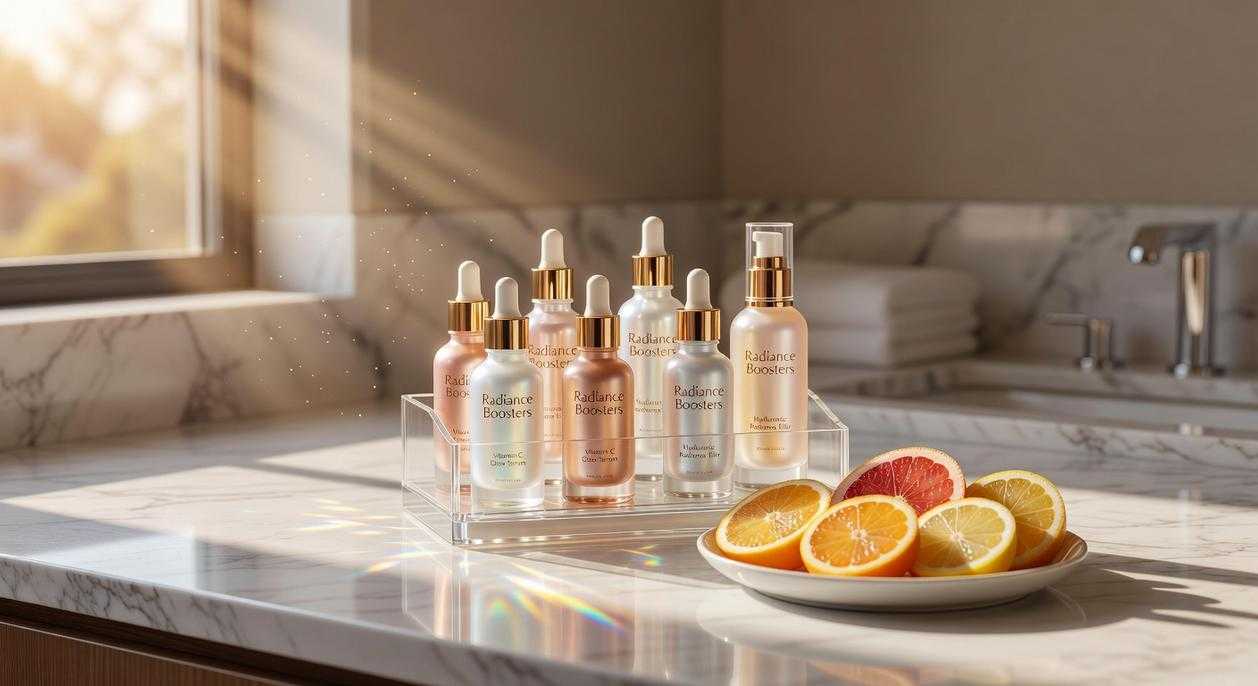
First, let’s talk about the “why.” When skin is dehydrated, its cells become shrunken and flat, creating a rough, dull surface that barely reflects light. In contrast, hydrated skin cells are plump, smooth, and bouncy—meaning they catch light beautifully (think glazed-donut glow, not desert floor).
So what makes the difference? It comes down to formulation.
Humectants vs. No Humectants
On one side, you have ingredients like Hyaluronic Acid and Glycerin. These are humectants—ingredients that attract and bind water. Picture them as moisture magnets, pulling hydration from the air and deeper skin layers into the epidermis. Without humectants, your skin drinks nothing. With them, it holds onto precious water.
However, hydration alone isn’t enough.
Barrier Support vs. Water Loss
If you skip barrier-repair ingredients, that hydration simply evaporates (a process called transepidermal water loss). Enter Ceramides and Fatty Acids—the “mortar” between your skin cells. They seal gaps, reinforce the barrier, and lock moisture in place.
Pro tip: For maximum impact, apply a hyaluronic acid serum to damp skin first, then seal it in with a ceramide-rich moisturizer. That’s how glow boosting formulations truly work—layered, not rushed.
Advanced Formulations for Long-Term Luminosity
Let’s be honest: chasing glow with quick-fix masks and highlighters gets exhausting. You want radiance that’s real—not the kind that disappears by lunchtime. That’s where advanced glow boosting formulations come in. Instead of sitting on the surface, these ingredients communicate with skin cells (meaning they influence how cells function and renew themselves) to create lasting change.
First, niacinamide—also known as Vitamin B3—is the ultimate team player. It visibly brightens uneven tone, reduces the appearance of enlarged pores (those stubborn ones that never seem to shrink), calms redness, and strengthens the skin barrier, which is your skin’s protective shield against moisture loss and irritation. In other words, it multitasks so you don’t have to layer five different serums.
Then there are retinoids, including retinol and retinal. Often called the gold standard in dermatology, retinoids increase cellular turnover—the rate at which old cells shed and fresh ones rise to the surface (American Academy of Dermatology). The result? Consistently smoother, brighter-looking skin.
Now, some argue retinoids are too irritating. That can be true—if overused. Start low (0.1–0.3%) twice weekly and increase gradually. Meanwhile, add niacinamide morning or night to support balance and resilience.
As we delve into the illuminating world of glow-boosting formulations in modern skincare, it’s equally important to consider how our makeup choices, like whether Zosisfod Eye Brow Pencil is bad for eyebrows, can impact overall skin health and radiance – for more details, check out our Is Zosisfod Eye Brow Pencil Bad For Eyebrows.
Building Your Personalized Radiance-Boosting Routine
You came here looking for a clear, simple way to achieve lasting radiance—and now you have the blueprint. By focusing on protective antioxidants, resurfacing exfoliants, plumping hydrators, and restorative cell-communicators, you can confidently choose glow boosting formulations that actually support your skin’s needs.
The real frustration isn’t a lack of products—it’s not knowing which concern to tackle first. Instead of layering everything at once, identify your biggest barrier to glow, whether it’s texture, dehydration, or uneven tone. Start with one targeted formulation and build from there.
Ready for real results? Choose your primary concern today, commit to one proven formulation, and begin your streamlined routine for a healthy, consistent glow.
 Ask Kathryn Holmeseweads how they got into beauty buzz and you'll probably get a longer answer than you expected. The short version: Kathryn started doing it, got genuinely hooked, and at some point realized they had accumulated enough hard-won knowledge that it would be a waste not to share it. So they started writing.
What makes Kathryn worth reading is that they skips the obvious stuff. Nobody needs another surface-level take on Beauty Buzz, Beauty Product Optimization Tips, Expert Breakdowns. What readers actually want is the nuance — the part that only becomes clear after you've made a few mistakes and figured out why. That's the territory Kathryn operates in. The writing is direct, occasionally blunt, and always built around what's actually true rather than what sounds good in an article. They has little patience for filler, which means they's pieces tend to be denser with real information than the average post on the same subject.
Kathryn doesn't write to impress anyone. They writes because they has things to say that they genuinely thinks people should hear. That motivation — basic as it sounds — produces something noticeably different from content written for clicks or word count. Readers pick up on it. The comments on Kathryn's work tend to reflect that.
Ask Kathryn Holmeseweads how they got into beauty buzz and you'll probably get a longer answer than you expected. The short version: Kathryn started doing it, got genuinely hooked, and at some point realized they had accumulated enough hard-won knowledge that it would be a waste not to share it. So they started writing.
What makes Kathryn worth reading is that they skips the obvious stuff. Nobody needs another surface-level take on Beauty Buzz, Beauty Product Optimization Tips, Expert Breakdowns. What readers actually want is the nuance — the part that only becomes clear after you've made a few mistakes and figured out why. That's the territory Kathryn operates in. The writing is direct, occasionally blunt, and always built around what's actually true rather than what sounds good in an article. They has little patience for filler, which means they's pieces tend to be denser with real information than the average post on the same subject.
Kathryn doesn't write to impress anyone. They writes because they has things to say that they genuinely thinks people should hear. That motivation — basic as it sounds — produces something noticeably different from content written for clicks or word count. Readers pick up on it. The comments on Kathryn's work tend to reflect that.