
If you’re searching for real answers about how a brightening serum actually works—and whether it’s worth adding to your routine—you’re in the right place. With countless products promising radiant, even-toned skin, it’s easy to feel overwhelmed by marketing claims and unclear ingredient lists.
This article breaks down the brightening serum science behind effective formulations, explaining how key ingredients target dullness, hyperpigmentation, and uneven texture at a cellular level. You’ll learn what actually drives visible results, how to choose the right formulation for your skin type, and how to optimize application for maximum absorption and glow.
Our insights are grounded in evidence-based skincare research, ingredient analysis, and formulation best practices used in modern cosmetic science. Instead of hype, you’ll get clear, practical guidance rooted in dermatological principles—so you can make informed decisions and build a routine that truly supports brighter, healthier-looking skin.
Unlock Your Brightest Skin: The Science Behind Radiance
First, let’s cut through the glow-up hype. Radiance starts at the cellular level. Melanin, the pigment that gives skin its color, is produced by cells called melanocytes. When overproduced—thanks to UV exposure or inflammation—it creates dark spots. Ingredients like vitamin C (ascorbic acid) inhibit tyrosinase, the enzyme that drives melanin synthesis, as shown in dermatology studies (Journal of Clinical and Aesthetic Dermatology, 2017).
However, not every formula works. In my opinion, brightening serum science matters more than branding. Niacinamide reduces pigment transfer, while alpha arbutin slows production.
So, choose evidence over promises
How Do Brightening Serums Actually Work? A Look at the Biology
If you’ve ever wondered why some dark spots fade while others cling on like a bad sequel, it comes down to melanin. Melanin is the pigment that gives skin its color, produced by specialized cells called melanocytes. The key enzyme driving this process is tyrosinase—think of it as the on-switch for pigment production. When tyrosinase activity increases (due to sun exposure, inflammation, or hormones), uneven tone follows. According to the American Academy of Dermatology, UV exposure is one of the biggest triggers of excess melanin production.
Here’s where brightening serum science gets interesting. Effective formulas typically work by:
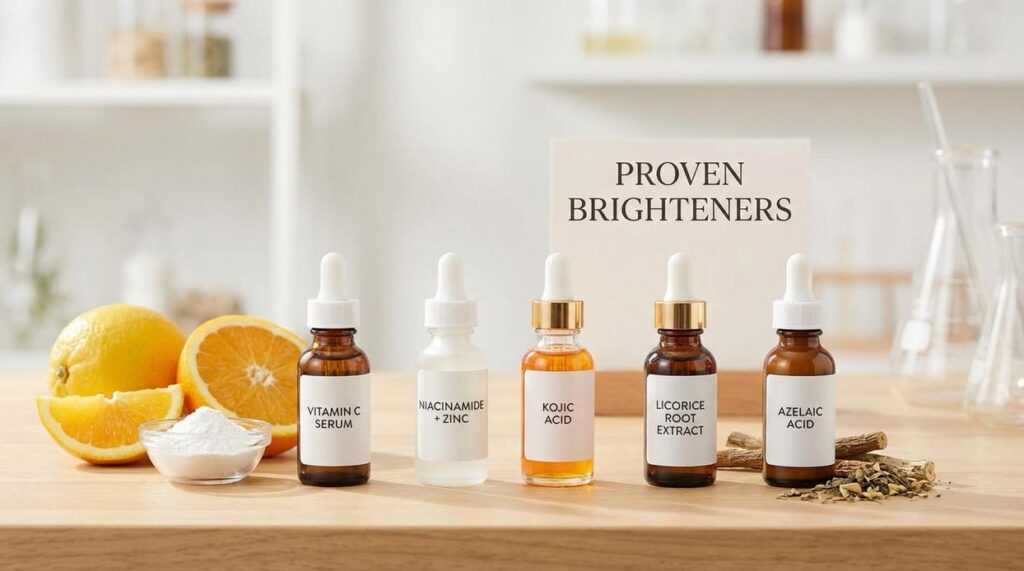
- Inhibiting tyrosinase, slowing pigment creation (ingredients like vitamin C and kojic acid do this).
- Blocking melanin transfer to surrounding skin cells (niacinamide is a standout).
- Increasing cellular turnover, helping shed pigmented cells faster (retinoids and AHAs lead the charge).
Personally, I prefer serums over creams for targeting discoloration. Serums have smaller molecular structures and fewer occlusive agents, allowing deeper penetration into the epidermis. Creams are great for sealing moisture, but when I want results, I reach for concentrated actives first (then layer a cream on top—pro tip).
Some argue brightening products are overhyped. I disagree. When formulated well and used consistently, the biology clearly supports their impact.
The “Gold Standard” Brightening Ingredients Backed by Research

When dermatologists call an ingredient the GOLD STANDARD, they mean it has both lab data and real‑world results to back it up (not just glossy marketing). Here’s what truly earns that title.
Vitamin C (L‑Ascorbic Acid & Derivatives)
Pure L‑Ascorbic Acid is a potent antioxidant, meaning it neutralizes free radicals—unstable molecules created by UV exposure and pollution that trigger excess pigment. It also inhibits tyrosinase, the enzyme responsible for melanin production. Clinical studies show topical vitamin C significantly reduces hyperpigmentation and improves brightness over 12 weeks (Journal of Clinical and Aesthetic Dermatology, 2017).
On skin, it often feels slightly tingly and dries with a barely there tack before melting into a smooth finish. Stable derivatives like Sodium Ascorbyl Phosphate are gentler and less prone to oxidation (that metallic scent? That’s instability). Critics argue vitamin C is too unstable to bother with. Fair—but modern formulations and airless pumps have improved shelf life dramatically.
Niacinamide (Vitamin B3)
Niacinamide works differently: it blocks the transfer of melanosomes (pigment packets) to keratinocytes (surface skin cells). A double‑blind study published in the British Journal of Dermatology (2002) showed 5% niacinamide reduced hyperpigmentation after 8 weeks.
It feels silky, almost cushiony, and layers beautifully. Some claim it’s “too mild” to make a difference. Yet its ability to refine texture, minimize redness, and strengthen the barrier makes it a QUIET POWERHOUSE.
Alpha Arbutin & Kojic Acid
Both are direct tyrosinase inhibitors. Alpha arbutin is derived from bearberry plants; kojic acid comes from fermented fungi (yes, like sake). They’re often considered safer alternatives to hydroquinone, especially for long‑term use. Skin can feel smooth and luminous within weeks.
| Ingredient | Primary Action | Best For |
|---|---|---|
| Alpha Arbutin | Tyrosinase inhibition |
Stubborn dark spots |
| Kojic Acid | Melanin suppression | Uneven tone |
Skeptics note slower results compared to prescriptions—but fewer irritation issues make them IDEAL for consistent use.
Azelaic Acid
Azelaic acid reduces inflammation, inhibits tyrosinase, and normalizes cell turnover. Research in Dermatologic Therapy (2011) supports its efficacy for acne and melasma. It can feel slightly creamy with a faint medicinal scent, but redness and post‑blemish marks visibly soften.
Licorice Root Extract (Glabridin)
Glabridin calms inflammation and suppresses melanin production. Frequently used for sensitive skin, it leaves a soothing, almost velvety finish.
If you’re exploring brightening serum science, understanding how these actives interact is crucial. For a deeper dive into formulation strategy, see balancing actives and botanicals in glow focused products.
Maximizing Your Glow: How to Integrate a Brightening Serum into Your Routine
I’ll admit it—I used to slather on my brightening serum whenever I remembered. Sometimes before moisturizer, sometimes after. Once (big mistake), I even layered it over SPF. Unsurprisingly, my results were… underwhelming.
First, order matters. Cleanse → Tone → Brightening Serum → Moisturizer → SPF. Applying serum to clean, slightly damp skin improves absorption because damp skin is more permeable (think of it like a sponge that hasn’t fully dried). This is basic brightening serum science, yet it’s easy to overlook.
Next, timing. In the morning, Vitamin C works best thanks to its antioxidant properties that help defend against pollution and UV-induced free radicals (Pinnell, 2001). At night, ingredients like Niacinamide or Azelaic Acid support repair and target uneven tone while you sleep. I learned the hard way that using everything at once only irritated my skin.
However, none of this works without sunscreen. UV exposure is a leading cause of hyperpigmentation (AAD), so skipping broad-spectrum SPF makes brightening efforts counterproductive.
Finally, be patient. Skin cell turnover takes weeks. Most clinically tested serums show visible improvement after 8–12 weeks of consistent use. Glow is earned, not rushed.
Your Path to a Radiant, Even-Toned Complexion
You now understand the basics of brightening serum science. The next step? Put that knowledge into action.
Uneven skin tone happens when excess melanin—the pigment responsible for skin color—is overproduced in certain areas. Instead of buying whatever promises “glow,” focus on ingredients that interrupt this process at its source.
Here’s a simple routine you can follow:
- Morning: Apply a Vitamin C serum to help neutralize free radicals (unstable molecules that accelerate skin damage) and support brighter-looking skin.
- Evening: Use Niacinamide to reduce discoloration and Azelaic Acid to calm inflammation and refine tone.
- Daily: Finish with broad-spectrum SPF 30+ to prevent new dark spots from forming.
Some argue that natural oils alone can even out skin tone. While they may hydrate, studies show ingredients like Vitamin C and Niacinamide have clinically supported brightening effects (Draelos, 2013, Journal of Clinical and Aesthetic Dermatology).
Check your labels. If these ingredients aren’t listed near the top, it may be time to upgrade.
You came here looking for real answers about achieving brighter, healthier-looking skin—and now you understand how the right ingredients, consistency, and application techniques work together to deliver visible results. The frustration of dull tone, uneven texture, and products that overpromise but underdeliver is real. That’s why understanding brightening serum science changes everything.
When you know how active ingredients target pigmentation, support cell turnover, and protect your skin barrier, you stop guessing and start seeing progress. The key is choosing formulations that are backed by research, layered correctly in your routine, and optimized for your unique skin needs.
Ready for Your Glow Upgrade?
Don’t let stubborn dark spots or uneven skin hold you back any longer. Discover proven routines and expertly crafted formulas designed to deliver visible radiance. Join thousands who trust our top-rated skincare insights and start transforming your glow today. Explore the right brightening solution now and take the first step toward the luminous skin you deserve.
 Ask Kathryn Holmeseweads how they got into beauty buzz and you'll probably get a longer answer than you expected. The short version: Kathryn started doing it, got genuinely hooked, and at some point realized they had accumulated enough hard-won knowledge that it would be a waste not to share it. So they started writing.
What makes Kathryn worth reading is that they skips the obvious stuff. Nobody needs another surface-level take on Beauty Buzz, Beauty Product Optimization Tips, Expert Breakdowns. What readers actually want is the nuance — the part that only becomes clear after you've made a few mistakes and figured out why. That's the territory Kathryn operates in. The writing is direct, occasionally blunt, and always built around what's actually true rather than what sounds good in an article. They has little patience for filler, which means they's pieces tend to be denser with real information than the average post on the same subject.
Kathryn doesn't write to impress anyone. They writes because they has things to say that they genuinely thinks people should hear. That motivation — basic as it sounds — produces something noticeably different from content written for clicks or word count. Readers pick up on it. The comments on Kathryn's work tend to reflect that.
Ask Kathryn Holmeseweads how they got into beauty buzz and you'll probably get a longer answer than you expected. The short version: Kathryn started doing it, got genuinely hooked, and at some point realized they had accumulated enough hard-won knowledge that it would be a waste not to share it. So they started writing.
What makes Kathryn worth reading is that they skips the obvious stuff. Nobody needs another surface-level take on Beauty Buzz, Beauty Product Optimization Tips, Expert Breakdowns. What readers actually want is the nuance — the part that only becomes clear after you've made a few mistakes and figured out why. That's the territory Kathryn operates in. The writing is direct, occasionally blunt, and always built around what's actually true rather than what sounds good in an article. They has little patience for filler, which means they's pieces tend to be denser with real information than the average post on the same subject.
Kathryn doesn't write to impress anyone. They writes because they has things to say that they genuinely thinks people should hear. That motivation — basic as it sounds — produces something noticeably different from content written for clicks or word count. Readers pick up on it. The comments on Kathryn's work tend to reflect that.